

 +44 7418377397
What Is a Desk Rejection in the Peer Reviewed Process?
A desk rejection occurs when a peer reviewed journal declines a manuscript before it reaches a single external reviewer. The editor-in-chief or managing editor makes this decision, typically within 48 to 72 hours of submission. No subject matter experts are consulted. No detailed feedback is provided. The paper is returned at the editorial level, often with a brief, standardized note.
This is not an anomaly. It is the norm.
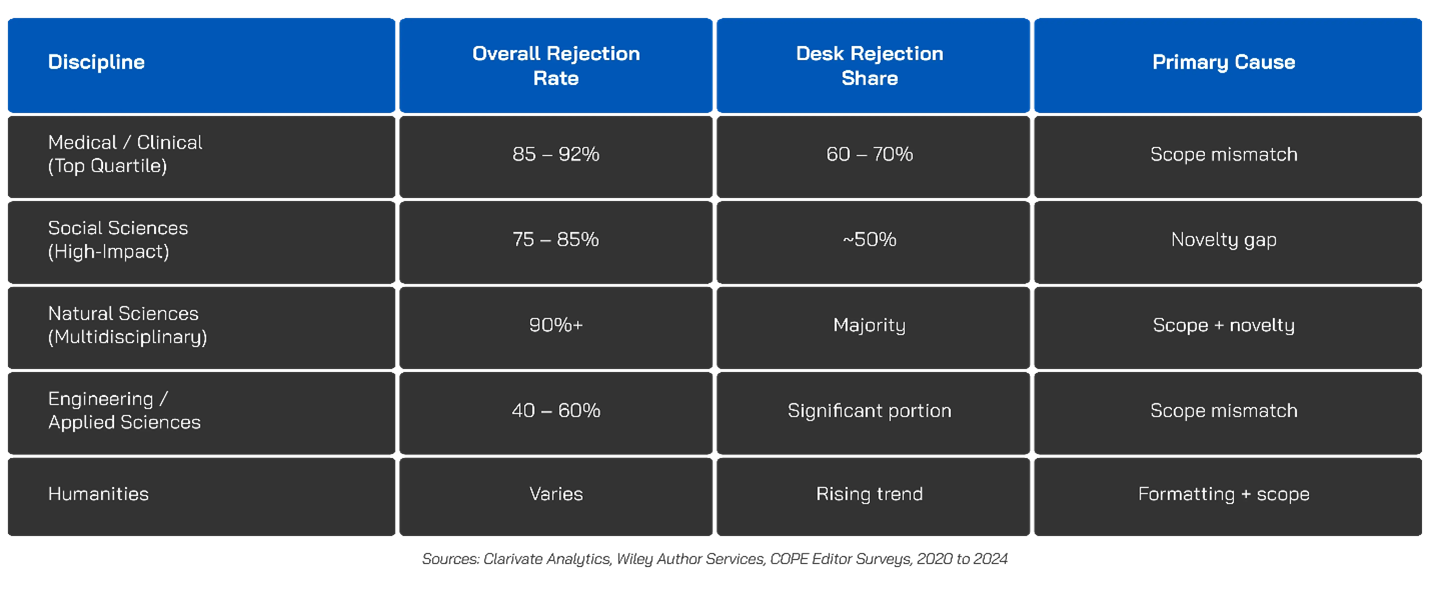
According to data compiled by the European Association of Science Editors, desk rejection rates at high-impact journals routinely exceed 60%. At elite multidisciplinary publications, that figure surpasses 80%. Researchers who do not understand this process are operating at a significant disadvantage before they even begin.
How Common Are Desk Rejections? (Key Statistics by Discipline)
Technical Reasons Journals Reject Papers Immediately
These causes are entirely preventable. They are also among the most common.
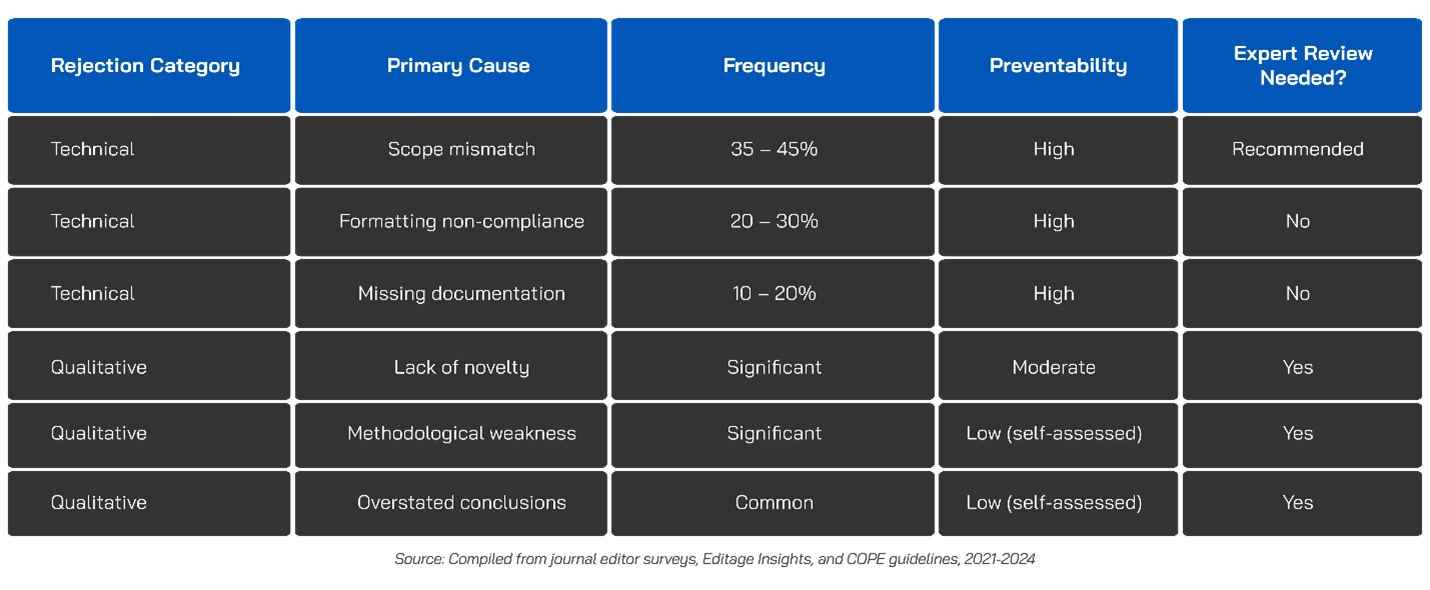
Formatting Non-Compliance: Every peer reviewed journal publishes detailed author guidelines covering reference style, word count, figure resolution, section structure, and font requirements. Submitting a manuscript formatted for a different journal signals to editors that the author did not read the submission requirements. That signal alone is sufficient grounds for rejection.
Scope Mismatch: A paper on drug response rates in oncology does not belong in a public health policy journal, even if the implications overlap. Editors make scope decisions in minutes. If the abstract and introduction do not map directly to the journal's stated aims, the submission will be declined before anyone reads the methodology.
Incomplete Documentation: Missing ethics approval statements, absent conflict-of-interest disclosures, and omitted cover letters are immediate disqualifiers at journals with compliance standards. These are not treated as oversights. They are treated as procedural failures.
Qualitative Reasons: The Problems Harder to Self-Diagnose
Technical errors are fixable. Qualitative weaknesses are more consequential and far more difficult to detect without outside perspective.
Lack of Novelty: Peer reviewed journal articles must advance a field. They cannot simply confirm existing findings or replicate prior studies without meaningful extension. If the research question does not offer a new angle, or if the theoretical contribution is unclear, an experienced editor will identify this immediately. The core editorial question every submission must answer is: what does this work add that does not already exist in the literature?
Weak or Inconsistent Methodology: Underpowered sample sizes, poorly described control conditions, and analytical methods that do not align with the research design are recurring problems that prompt early rejection. Senior editors at leading journals possess enough methodological expertise to identify these issues without external review.
Overstated Conclusions: When claims extend beyond what the data can reasonably support, editors flag it as a credibility issue. Researchers who are invested in their findings often overstate significance without realizing it. This is one of the most common reasons manuscripts are rejected without review.
Technical vs. Qualitative Rejection Causes: A Comparison
Why Expert Consultation Directly Reduces Rejection Risk
Most researchers prepare and submit manuscripts without any external review of the submission strategy itself. This is one of the most consistent and correctable patterns among authors who experience repeated desk rejections.
Expert consultation addresses both layers of the problem.
On the technical side, a qualified consultant audits the manuscript against specific journal formatting requirements, verifies that all required documentation is present, and confirms that the scope alignment is accurate before submission.
On the qualitative side, expert consultation provides something most researchers cannot generate independently: an objective, editorially informed assessment of novelty, methodological integrity, and the strength of the conclusions relative to the data. This is the same evaluative lens an editor applies in the first 10 minutes of reading a submission.
For researchers targeting high-impact peer reviewed publications, expert consultation is not a supplementary service. It is a strategic input that changes outcomes.
What Makes Peer Reviewed Journal Articles Succeed in a High-Volume Environment
Global research output has grown significantly over the past decade. More submissions mean more competition for limited editorial attention. In this environment, peer reviewed journal articles that advance past the desk stage share identifiable characteristics:
- The journal selection is precise, not aspirational
- The manuscript is formatted to that journal's exact specifications
- The novelty claim is clearly articulated in the abstract and introduction
- The methodology is described with enough specificity to signal rigor
- The conclusions are proportionate to the findings
None of these qualities emerge by accident. They are the result of deliberate preparation and, increasingly, of structured expert consultation with professionals who understand editorial decision-making.
Conclusion: Desk Rejection Is Predictable and Preventable
Rapid rejection follows identifiable patterns. Those patterns respond directly to preparation and informed submission strategy.
Researchers who treat journal submission as the final administrative step in the research process will continue to encounter high rejection rates. Those who approach it as a discipline that benefits from expert consultation, journal-specific formatting review, and objective novelty assessment will see measurably different results.
The peer reviewed publication process is competitive by design. Entering it without professional guidance is a decision with real consequences for research visibility, career trajectory, and the time invested in producing the work.
The question is not whether expert consultation adds value to the submission process. The evidence is consistent that it does. The question is whether researchers can afford to keep submitting without it.
Ready to improve your manuscript's acceptance rate? Professional academic consultants specializing in peer reviewed journal article submissions can help researchers at every stage, from journal selection to final formatting review. Expert consultation is the strategic advantage that separates accepted manuscripts from desk rejections.